
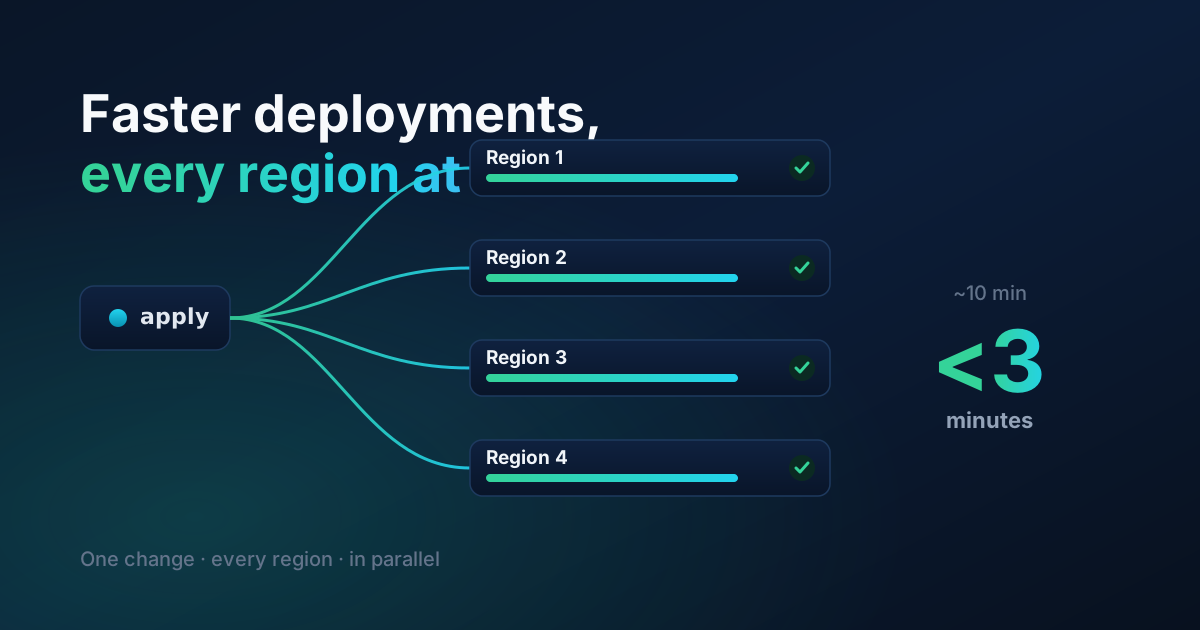
Your deployments just got faster across every region
Deployments on Bahriya now reach every region in under three minutes. Rollouts run in parallel across regions, with no change to your workflow.
Ship an update to your containers today and it reaches every region in under three minutes — down from around ten. Same command, same workflow, noticeably less waiting.
What changed
When you deploy or update a container, that change has to roll out to each of the regions you run in. Previously those rollouts happened one region after another, so the more regions you ran in, the longer you waited for a change to be live everywhere.
We rebuilt the system that carries your changes to the clusters. Regions now roll out in parallel rather than in sequence, and the whole path from "apply" to "running" is leaner. The result is a rollout that finishes in under three minutes across every region, consistently — whether you deploy from the console, the CLI, or Terraform.
What you need to do
Nothing. This is live for every project. Your next reis apply, Terraform run, or console deploy already takes the faster path.
Why it matters
Faster rollouts mean tighter feedback loops. A config tweak, a new image tag, a scaling change — you see it live across your whole footprint in the time it takes to read a short email, not long enough to lose your train of thought. And because every region converges independently, a slow or busy region no longer holds up the rest.
We think the engineering behind this is worth a closer look — how we moved from a general-purpose pipeline to a purpose-built, region-parallel deployment engine, and why resilience and disaster recovery drove the design as much as speed. If that's your kind of thing, read the deep dive: Rebuilding our deployment engine.
From the knowledgebase